Showing posts with label cairo. Show all posts

6.10.2008

Kelvin's Fair to Middlin' List of Things YOU Can Do to Help

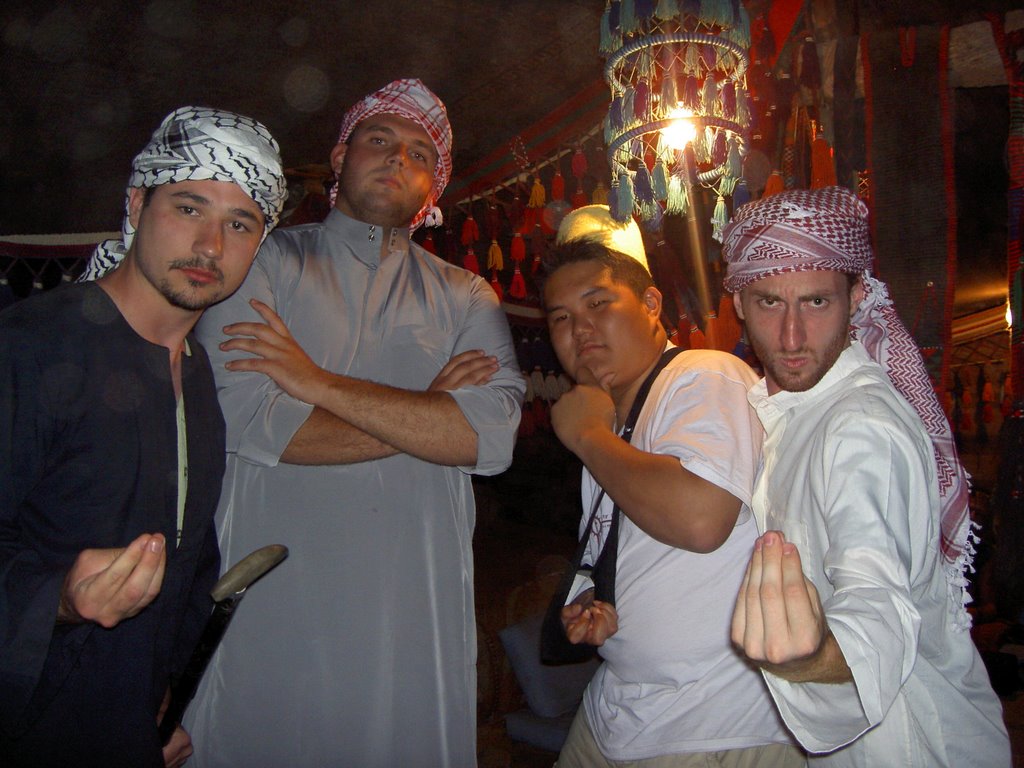
Passing through LA on my way to Cairo, I met this guy on his way to Lima. We were both heading to our Global Urban Trek cities. We might never pass the same way again, but at least there are the internets. He's done a much more efficient job of directing his energy on the behalf of people in need than I have, and his blog Notes from the Overground has a lot of his interesting thoughts as he actually tries to practice his beliefs. He recently made this post of things that members of the general public can do to contribute. I like it, so I'm posting it here too.
Thanks.

Mango'd

Today I shared 2 mangoes with a housemate.

After unsuccessfully cutting most of the the fruit away, I tried the soft yellow around the seed with my teeth.

And I found myself again in Cairo. I felt it before I recognized it. I felt it before my mind filled in the nighttime, people, traffic, and dust.

There are not juice stands here, on every other corner, the way they are in Cairo. The sense Mango filling my mouth and the memories that filled my brain took me back to buying glasses of fresh mango juice from the juice stands - a tall glass filled with liquid fruit - we competed with each other to find the best and cheapest stands.

I maintain that Tiff and I won.
I don't remember the exact price, but I remember it was less than anything else we knew of, and the juice was first rate - eating mangoes that you didn't even have to chew. The place is in Arbaa-Wa-Noos - I think it's in the Northeast. Hop in a mini bus that goes to Seleb! Seleb! Seleb! and get off when you see the sign for the textile factory: 'ال سلاب,' if I remember right. There was construction here, a few years ago, so it probably looks different now. But find the school - ask someone to take you to Central, school for displaced Sudanese. Stop at the school and play jumprope with the kids and drink tea with the teachers. Ask them if they ever got the pictures we took with them. Ask them whose gone back to Sudan and if there are new teachers. Ask them if Bafi is still there, or if he and his family have made it out. Then keep going down the direction you were headed in. I think you'll come to a fork in the path between sand and abandoned buildings. They're not abandoned - most buildings are not falling apart but rather are unfinished, so as to avoid the tax that applies to completed buildings. Take the right fork. In that direction, I think, and not too much farther, is the best mango juice stand I know of.

It's past Gheda's house and near the restaurant where we took her out to dinner. Gheda, who spoke a little more of our language than we knew of hers, who was engaged to be married, who invited us into her home, and whose friendship with us consisted mostly of smiles, nods, and laughter to replace the words, but none of it ingenuine.

I am going against Pascal's musings.
I am trying to be everything
Is this why I unravel?

Is anything correlated?

I think I cast the thread of these stories in the partial hope that someone will recognize the spool that spins them or the fabric they might be trying to weave.


I hardly dare ask for causes,
but is anything correlated?

2.19.2008

Do What You Can

With What You Have
Where You Are
-Teddy Roosevelt


I had always looked at this as a sort of consolation quote. It was the sort of quote I thought would be spoken so someone who'd applied for some aspiration and been denied, the quote that consoles you with the reminder that even the little you have right around you can be put to use. It was the quote to pull out when you couldn't manage to accomplish something greater.

but really,

Not only are those probably both your most powerful tools and your most direct responsibilities,

but anything further (...perhaps without due attention to every thing having its season and a time to every purpose... ) may overextend your abilities, drain your resources, and detach you,
draining your energy inefficiently and leaving you oddly displaced.


I would do well in the midst of large systems to remember both my limits and the words of a friend,
- to do what I can
and then be done with it.


A vital thing to learn,
responsible management of resources
and it reminds me a bit of this post.

5.04.2007

Last Showing

After the last showing of A Long Walk Home, a lot of people stuck around to hear me trying to answer questions. I really appreciate the amount of questions asked, even though most were by the same two guys.
I was told later that I presented myself as being rather personable, and that's what I'm going for. I think that encourages people to engage the material and ask questions more.

I really appreciate people being interested and giving me the chance to speak about things which I start to forget until I hear myself saying them again. And I still don't know what it is. There is something, some topic, some theme, some expression - that when my explanation gets too close to it, my throat tightens up and my voice gets wavery and it seems best to stop and pretend to think or to just start the movie because if I try to talk any longer, I won't sound right.

Way at the end, the Student Volunteer Coordinator asked me some questions about what I thought of the organization I went to Cairo with and whether I'd recommend it for other students.

I didn't know what to say.
I wanted to compare it to recommending that someone see Requiem for a Dream, but she hadn't seen that movie.

She asked if I thought it was a good experience.

I didn't know what to say.

I wanted to hear myself say, "Yes, it was a wonderful learning experience, I'd recommend it for anyone wanting to go into summer volunteer work."

But that's just not true.
If someone really looked into it and decided that it aligned with what they wanted to put their energy towards, I guess I'd recommend it, but by then, that person would no longer need my recommendation.


Was it good?

I still don't know exactly how it's been working through my system.

I am continually grateful for the very existence of Ethan Rafal.

It hasn't helped me with school work.
I think it's contributed to a scattering of my sense of relation to other people.
It keeps asking me to question my sense of social responsibility.
It concretely confronts me deep problems in human society that I cannot solve.
It shakes my concept of what I can accomplish and how.
It feels like a dream sometimes.
But I know I can't forget it.
It introduced me to people and places that I chose to love in 5 weeks, and that I may never see again.
It challenged my ability to see justice and injustice
and my own responsibility (and patience) toward that.

It gave me few real answers,
except that God is good and trustworthy.


It was real.
It is real.
It is true. Therefore, it is good for me.
I will learn to deal with truth.

I cannot walk away from it.
It is not over.
I can never talk about it as if it was something that happened.
It is still happening.


Yes.
For me, it was good.
It is good.


But I would like to understand what has been changing in me and how.
And what it means that it is still real
the people I met and places I went are still true.

I forget how deep this goes
until someone asks, and they actually care so
I try to explain

And, I can't because my voice has stopped.
my voice is drowned
because my eyes are overflowing with water.


And I want to do my homework, but I feel rather emptied.

5.03.2007

Feliz Tres de Mayo

to me.

This is the 1 year anniversary of what I consider to be my personal emancipation day. I am constantly struggling to remember and to use the freedoms I have.

In honor of (I don't want to call it an 'Independence Day'... and 'Freedom day' sounds too trite) Yom Talata, I'm posting some drawings I made before and after going to Cairo.

Happy Dreitag.


A few days before leaving for Cairo:


Upon my return, ~5 weeks later:


and now:


It is difficult to remember sometimes.
I haven't walked through all the walls I could've,
and I must be more careful about the manner with which I disregard some.
Sometimes people don't expect it.
Sometimes I don't expect it.
Sometimes I keep my walls because they make sense to me somehow.

But, I'm still trying. I go in and out of my cages. I forget and remember again.
But, I'm trying.
I've been trying.
I will keep trying until I can recognize the illusions,
and see through them to my fellow human beings, the way God sees them, on the other side.

And there won't be sides anymore.

5.02.2007

Stories from a Refugee School


Tonight at 7:30
Psych 105

There are things outside the Bubble that we need to talk about.

4.24.2007

Tonight: A Long Walk Home


(There will be a second showing on Friday 5/4)

4.18.2007

Stories from a Sudanese Refugee School in Cairo

They were displaced from Sudan to Cairo,
Their stories have been carried from Cairo to America,

and I have been a terrible messenger thus far, but it's going to happen.
Getting A Long Walk Home in has been really helpful for seeing concretely what can happen, I think.

I got the ball rolling today, so now I have no more delays or excuses.


4/24 -Movie- A Long Walk Home
5/2 -Talk- Stories from a Sudanese Refugee school in Cairo -Tracy Mehoke
5/4 -Movie- One more showing of 'A Long Walk Home'

*********
As some of you know,
I volunteered at a school for Sudanese Refugees in a slum in Cairo last
summer. It's taken me waaay too long, but I'm finally putting together
an open-campus Show-and-Tell from Cairo.


I will share my story of 6 weeks as an American volunteer in Cairo as
well as the stories of my teachers who were there as Sudanese refugees
in Cairo. Some background information on the conflict in Sudan will be
explained. Ethan Rafal (http://ethanrafal.com/), a Reed graduate who
has actually been to Sudan, will make a guest appearance, /Inshallah/.

The 2 parts are

*#*
A screening of the Documentary (about 45 minutes long) about the
displaced Sudanese in Cairo 'A Long Walk Home'
http://www.alongwalkhomefilm.org/
A Long Walk Home was shot in Cairo, partially at the school I worked at,
during the summer before I got there (2005). Some of my teachers were
among those interviewed.

*#*
My presentation of my own story and the stories of those who cannot be
here to tell you

please set aside some calendar time now for at least one of these events:


1) NEXT TUESDAY, April 24th 7:30pm Psych 105

A showing of A Long Walk Home (I will be available for questions Afterward)


2) READING WEEK WEDNESDAY, May 2nd 7:30pm Psych 105

My talk (and pictures!) about the stories I brought back with me.
My stories come from the same places and people as were filmed in A Long
Walk Home,
Definitely Questions/Discussion afterward. Hopefully, food.


3) READING WEEK FRIDAY, May 4th 4:30PM Psych 105

One more showing of A Long Walk Home in case you missed it the first
time. Questions/Discussion time afterward.


I will have more official advertising out soon. In the meantime, feel
free to talk gregariously about this especially among people who don't
know anything about it yet.

***

4.17.2007

Memorial, take II

It's happened again.

I remember ... about 6 months ago interestingly enough were the high school shootings scattered around the country.

It is interesting to compare my reactions then to my reactions now regarding the Virginia Tech Shooting.
I think there's something to be said for my Egypt/America transitioning process.
This time around, I read the article from the NY Times page and was genuinely upset and concerned that such a thing of such a scale would happen in one of our schools.

Last fall, all I could think about was (cynically, and in a slightly scorning tone of thought that comes from wishing it had not been my first reaction)

What a lucky country we are ... we stretch to touch two oceans yet we all stop when a handful of our students are killed at their schools. What a lucky people we are, that a few deaths in a few states far away are one of our greatest concerns right now.
(This sounds horrendously callous - I'm sorry if you are one of those for whom the victims were more than a name, geography, and a tally)

I was thinking about my school in Cairo, many of the students or teachers at which had been tortured, had their families killed, and their villages burned and NO BODY KNOWS what's going on.

I wrote
While certainly larger, more noticeable events have more influence in the general historical conscience, ... to overlook the small, minor injustices in favor of only large events is to treat the disease with tissues.

I'm not sure how much I stand by that wording, but I know what I mean.

Anyway, everyone else seemed be be finding meaningful the process of remembering those dead and their attackers. Those few dead. Meanwhile, 80% of a country is being quietly massacred. I kept these thoughts to myself.

Because everyone else was putting together this lovely memorial:

(I will put pictures here later. It's getting too late right now. But it's pictures of prayers hanging from trees.)

Alongwalkhomefilm.org

I watched it tonight

...craning my neck around as though I could get a better angle to see into the window to Cairo that was my computer screen...

I'm very glad I didn't have to watch it alone.
One of my friends was there and allowed me to interrupt the film by pointing out kids from my classes or telling him about teachers I recognized.


I was there.

That's my school.

Those are my kids.


Everywhere I go,
I meet people that I will probably never see again.
But they're still real.

I understand better why exchanging photos seemed so important to the refugees.

4.13.2007

haunted

(Feeling relevant to THIS)

I just got this DVD today:
A Long Walk Home

The girl on the cover looks so much like one of the girls - Muahe - from the school I worked at.


The only time I've seen the DVD so far is BEFORE we went to Cairo.
Now,
it occurs to me that if I watch it, I will likely see many people and places that I not only recognize, but count as home and family in another world.

You can't see it,
and I don't know how to show you,

but the worlds, so necessarily separate, are mixing and I feel like I am swimming in a swirling gap between them. This is not a pleasant swimming and I don't know which way to go. I hope I can trust the current.
Where is the bridge?

Her picture calls to mind the other faces that I might recognize.
I am almost afraid to watch this DVD.
And I am ashamed for it.

So of course, I must.

What am I doing?

Let justice roll down like waters and righteousness like an ever-flowing stream
-Amos 5:24


I just came from a John Perkins lecture.
Here is some of his cool stuff

He talked about Justice.

He speaks against the prosperity gospel that is dulling our churches.

(I want to be a missionary to the American church)

Some of the things he said:
(These are pretty close to direct quotes, but I can't write fast enough)


What we have have done to day is reduce 'tolerance' down to nothin'. 'Let's not have any convictions,' and we'll all get along.

The art of preachin' is to share the love of God in a way that people can hear sufficiently and make a conscious decision based on their own convictions and the Holy Spirit and not be condemned by the preacher

Preachin' is to present truth in a way that people can come with a conviction and make the kind of decision of what they want to do in life.

Prosperity Christianity is the kind that will allow injustice to flourish.

Capitalism has bought off the church's voice because we have made money our God.


He asked, What is Justice? and proceeded:

Justice is stewardship. Justice is a management issue. The earth belongs to God, and the fullness thereof. In-Justice deprives people from access to God's creation. In-Justice deprives people of their part in the stewardship.

With our greed, we're destroying the very earth that we are supposed to manage and protect?

Our dignity is affirmed by our creativity.

I'm prayin' that this generation will be the one to make the American Creed a reality: 'We hold these truths to be self-evident...'

Hold it,
I don't wanna go back to the religion of the founding fathers - I'd be a slave.

My mother died of a disease brought on by lack of nutrition. She died of starvation.


He defines Education:

The ability to understand what is goin' on around you and get some skills to manage the environment (like Gen 1:26-28)

Don't let the environment crash in on you. Subdue it. Take your knowledge and turn it into technology.

The issue today is your values.
Who controls your values?


Most creative thinkers come out of prison ... (lists great men who had been imprisoned)... because in prison, you don't have anything to lose. In prison, you can go for it.

We have to bring Christianity back to its authentic faith in society. A new, more creative congregation in our community. Churches by race is not biblical. Whenever you get a sense of heaven, you see all people and all races praising God together. We gotta create a new community.


(cites religion being used to mobilize small groups of people to bring about the death of another in recent history)
This is the kind of religion in our society. We gotta create a new society.


Paul suffered for religion rather than suffering with it. (Gal 2:20)

In the process of falling in love, you want to love this person who you think loves you - I want to love this God ... (end of Matthew 25) .. by reaching out for the broken in society.

We have taken the precious love of God and put it in the culture in a way that loses its power.

I want to preach a gospel stronger than my race, ..stronger than (other characteristics of himself and of society)...
...that will deal with people that are aching in the world and in society.

We have to be forever seeking after the truth and examine it.

I really like Tylenol - it's good medicine, but it don't cure cancer

it's like religion - we go around saying 'Your truth is your truth and my truth is my truth' and they don't do nothin.' It makes me curse ...


YES,

I thought. Finally, it's so good to hear someone saying these things again. I went to hang around by the book signing after his lecture to ask questions about what he thought could be concretely done, and what the most immediate and efficient ways to do it might be.

I wanted to flip through his books and see the same resounding call for Justice and Education and against the prosperity Gospel that he spoke of in his lecture. Especially since one of them was Let Justice Roll Down. The title is part of Amos 5:24 which became the 'theme verse' of my project in the refugee schools of Cairo last semester during our study of the book of Amos. I wanted to page through and hear all of our struggles and convictions of last summer looking back at me from the page.

Even better, it had a foreword by Shane Claiborne the guy from The Simple Way. I wanted to read more of the same.

And then I realized,
I knew enough to know what the answers to my questions would be. To find something to do and do it. If I'm not already doing that, how can I expect to be responsible for the answer to my question?

And if I knew the material so well, that I wanted to read it and be affirmed and encouraged by seeing it in his book,
then why was I wanting to ask a question? Why did I want to come hear him speak again?

I know the basic philosophy of The Simple Way. I've heard Shane speaking about it on some CD tracks. I knew what I was going to see.

Why did I want to see it again? Just to make myself feel good for already knowing it? Just to feel like it was somehow speaking a language I understood?

What am I doing? I'm not nearly enough out there on ground level being the change I wish to see in the world. How dare I surround myself with repeating ideas of justice without actually having a clearer idea and intention of what to DO with it?

sometimes,
I make me sick

and then I try to blame it on the world and on society.


And for all this typing on Justice,
what am I doing?

4.10.2007

Contact

Spring and

the new leaves, vibrant green and deftly-lined
unroll like
wet butterflies


I have met Ethan Rafal,
which is something I have wanted to do for a while.
I heard about his forays into Uganda and Darfur, saw one of his photo exhibits, and even saw him speak at a Save Darfur Coalition event earlier on,
but I never actually met him.

What did I expect? A reed shaken with the wind?

I didn't have any concrete expectations of meeting him except maybe to hear some part of his story that would further affect my own.

I didn't have any plans to follow up a mutual introduction - I knew I wanted to meet him as if only good could come of it (and if I did not, to wonder forever what might've come from it). I wanted to meet him the way that two similarly shaded puzzle pieces with corresponding structure look like they should fit regardless of whatever picture that the puzzle might be supposed to look like.

The thing at that time is not to finish the puzzle but to just put those two pieces together.
I just wanted to meet him.


I'm very grateful for a remarkable turn of events and to Nelson Pavlosky for introducing us. This makes me think I may have been expecting something which I did not admit to myself, but which I nonetheless found.

As if connecting these two pieces might also connect their two halves of the puzzle.

I think,
he helps me believe that my stories are real
and that I didn't just dream them up like I thought I did with Readin' on a Dream. It was so good, but nobody else had heard of it. I began to wonder if I'd just invented the memory I thought I had.

It's disorienting when the things which seem like they should be so influential
seem the most likely to be all in your imagination.

I was thinking about what I would say, if I ever get to exchange and compare stories with him, and I feel like a hypocrite for feeling as if speaking with him somehow enables me to act on these stories, and for feeling as though somehow I am more encouraged to do this than I was alone. And by 'alone' I mean,

[now see,
if I could tell you exactly what I mean,
then I think I wouldn't be playing this warping mental game of 'Doctor, Doctor!']


because although I went with a family,
we returned separated
we each returned by ourselves to our former lives.
And, you can never really go back to a former life.

I feel like a hypocrite because I am so glad that he understands

(what does he understand? Again, if I could tell you...)

he understands, he must - he said some things that I don't think he would say otherwise.

I think he understands the conflicting frustrations and longings that eat at me,
This concept does strange things to my sense of gratitude -
as if I believed that no one else can actually listen to me when I tell the stories I carry - as if I believed that that's what I need, what they need in order to not shrivel up like a raisin.
But, I don't know whether that's a true representation, or just my mental explanation to myself.
Maybe that's just how I THINK I should feel.
And the mental knots twist again.


And I am sorry,
I am really sorry because my stories are not nearly as intense as his, and while I am encouraged that he understands me,
I wonder who understands him. Maybe there are things that I must still fit in their place, and when I have done this, I will have solved the riddle of the thing that coils inside me. Is it a parasite? A larvae? Will it consume me? Must I feed it?

Have I really felt so isolated? Have I really felt so trapped for so long?
It is difficult to say
You may not realize your traps until you come up against the bars.


I do not know the name of that which eats me


I think I am afraid that I will commit myself to a love that cannot be realized and will never recognize what I try to give to it.

3.25.2007

and Back Again

I remember sharply,
but not in detail,

telling you that I was concerned about my in/ability to interact with and care about people on a personal level.

And you laughed,
reminding me that I'd just gone all the way to Cairo for the purpose of volunteering in a school for refugees.

But I was serious.

And I didn't know how else to explain it - It was a feeling - I was describing a feeling that had acquired words only recently - so I had nothing else to say.

So I told myself that it was an amusing, though very troubling, irony.
And I let you laugh.


I have been finding words, slowly. A Taylor expansion of the idea, if you will.

I think it's easier to go all the way to Cairo.

And even while I was there, the thing that concerned me most was not the traffic or the language barrier, but whether I'd be able to deliberately move into meaningful interactions with the people in my group and the people at my school in such a short time, knowing that we would only be there for a matter of weeks.

(It's possible that this is only true in retrospect, and I may revoke these thoughts tomorrow, but)

I think I have been making a mistake
in supposing that I have a responsibility to handle myself, and if I cannot even do that, what hypocritical business have I wanting to help others?

and in supposing that I was too small and broken that I could not be used by God to work among people. He would have to rebuild me first.

I even have quoted on the sidebar, the great role to others that one man, broken on the wheels of living, can serve.
I think I had imagined that one must be adequately repaired, and one could not function while breaking or in a state of disrepair.

And it is good and responsible to know yourself, to handle yourself, but not when these preparations obstruct or delay or dismiss being helpful to others.

Because we are all blind and stumbling and breaking, caterpillars on the rim of a glass.* One of the few things we can have is each other. Perhaps I have no business or ability in guiding, but it matters that we let ourselves be led.

And I am being rebuilt, but by no means should this process inhibit me from giving of the little I have.

I have made the mistake of thinking that I must be careful to maintain and protect what has been given to me, since what I have is not my own.

And it is true, that it is not my own,
but my response should be instead to share it, to always risk breaking again. I am not rebuilt to last.

a candle must not fear fire
books were meant to be deshelved, read, and shared
tents were made to be weathered outdoors


God did not fix Moses or Gideon or Jonah or Abraham first.
He called them as they were.

This is sometimes frightening, but that's only when I forget that all I have is what's been given to me, and it was not given grudgingly - only when I am too distracted trying to keep my own head above water to feel the little nudging currents around me. I should know by now that when submerged, I am given gills.


* (There is a type of caterpillar which is blind and spends its larval stage in a sort of caterpillar herd. They move by feeling their brothers and sisters around them and moving with them. A scientist once placed these caterpillars around the rim of a glass, head to tail. Feeling the first one move, the rest followed, marching indefinitely forever in circles.)

12.11.2006

Tunnel Vision


It's finals week.
Studying etc is going pretty well,
but I want it to end.
I want to finish my work, leave these hallways and get back to the world outside where there is life and real things - I want to leave this cave of shadows.

By the way,
here is what is outside of the cave of shadows:


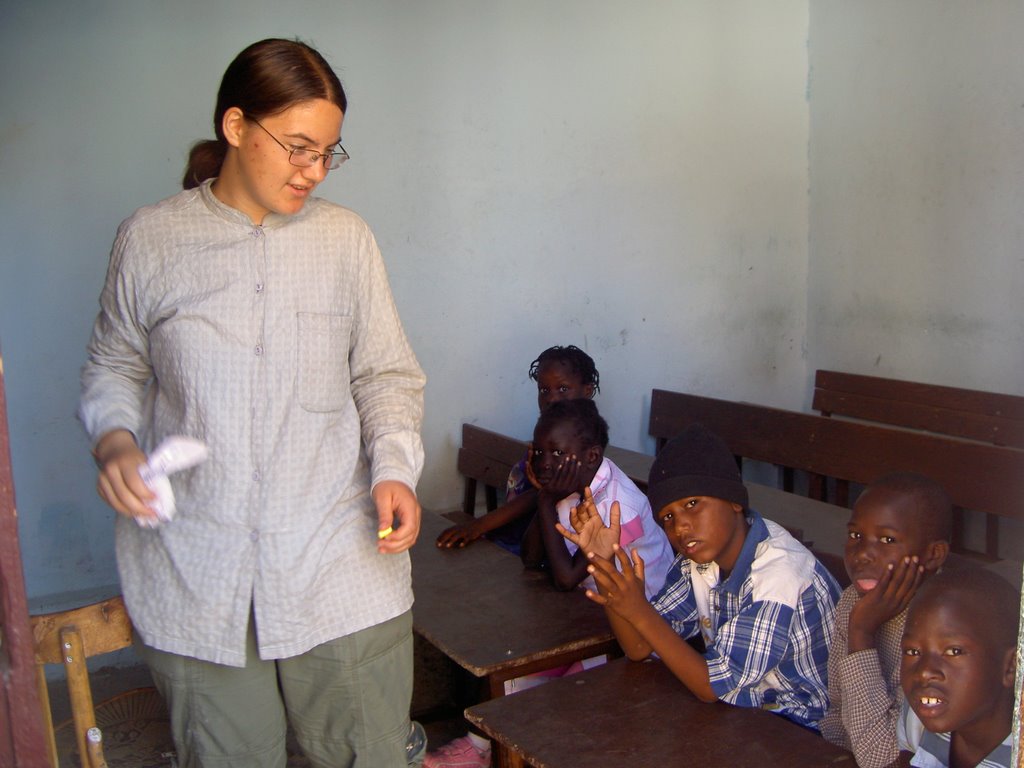
These are some of the kids I volunteered for over the summer.
You'll notice they each have a writing pad and a pencil. This is a great step up for the school from last summer. They are learning English, Music (songs), drama, and art. They might have math now that we're back into the regular school year.

While I'm sitting indoors on this couch reading scholarly articles about group theory and hyperbolic representations, wishing I could finish this and move on to the real world, ...

In the real world, kids are hundreds of miles away from home, haven't eaten breakfast yet, probably woke up somewhere between 3 and 5 to collect water for the day, and who knows if they'll ever live anywhere else, which they must because their original government has decided that they are not human enough to live and their temporary environment generally despises them for problems associated with being part of an influx of refugees to Cairo. And these are the lucky ones - the ones whose families can afford to send them to school.

And what am I doing?
today, I'm going to take a geometry test.

11.19.2006

Writing the Book

When I was in Cairo this summer, Sanaa and I met a girl about our age on the Metro. Rabab spoke way more of English than we spoke of Arabic, and after enough attempted conversation to get us past several Metro stops, she asked for our phone number - classic Egyptian hospitality. It always stunned me how genuine it was, too. That kind of stuff never happens around here. We'd spoken for a matter of minutes, and now we were the best of friends. We hurried to exchange phone information before scrambling to get off of the Metro at our stop.

I never saw Rabab again, but Sanaa got a chance to talk with her on the phone, and to visit her and be visited. It was difficult to find a time to get together because Rabab was always busy with her school work and building robots. She's really smart, beautiful in her dress and head covering, and such a wonderfully kind person. So the guy who works at the place where she gets her robot stuff from must be really lucky.

This is how kind and inclusive Egyptian hospitality can be: we were invited to Rabab's engagement party of sorts. We felt incredibly honored. These sort of celebrations are very important to the families, and for us to be invited was a huge gift. I don't know if she and the robot shop guy were actually getting engaged - I tn it was more of a marking of the beginning of an official romantic relationship.
Sanaa,
you should correct me.

An official engagement is a huge deal. The phrase that means 'to get engaged' literally means 'to write the book,' which I think is beautifully poetic. I wore a black hair tie on one of my fingers as both a backup hair tie and because it kind of looked like a ring - which had the potential of preventing harrassment in the streets. I think one of my students asked me one day if I was engaged. I recognized the words for 'to write' and 'book' and she was pointing at my hair tie ring. But we were copying down words from the board and I thought she was just asking something about that. I don't actually remember how I responded. But it only occurred to me a few seconds later that perhaps that was what she was asking about.

When a couple writes their book, the man comes to the woman's house where all the close relatives have gathered. The woman comes in with a tea tray to offer tea to the man. As he takes it, she looks up and meets his eyes with hers. It sounds rather formalized, but in a culture where men and women do not make mutual eye contact and where family is so important, it gains vitality. Small things that our more casual culture practically takes for granted are loaded with a more profound significance in theirs.

It may seem repressive, but I've got to say, there's something really attractive-sounding about having distinguished, communally recognized sets of interactions.

I couldn't go to Rabab's party because I was going to the end-of-summer-school celebration at Central, which I would not have missed for the world. But Sanaa told me about it when we both came home.
"They held hands for the first time", she said, clearly almost as excited for Rabab as Rabab must have been. "Rabab was freaking out."
They also got to look each other in the eyes. This is a huge deal. In Egypt, opposite genders do not look each other in the eyes. This was very difficult for me when I got there, having been trained from a young age that not looking someone in the eyes when speaking to them was incredibly disrespectful. That's why it was so interesting when Sanaa told me, "Rabab says that's how she knows he respects her - he wouldn't look at her."

This makes a lot of sense actually. There's something personal about eye contact, but I suppose how you interpret that depends on how your culture raised you to think of it. Several of the Egyptian girls we met were rather adherent to their practice of Islam and to the modesty that comes with that practice. In my culture, refusing to look at someone is akin to not recognizing their presence, but to Rabab's culture, I think his refusal to look at her was a legitimate respect for her values and her modesty.
There is value in this understanding.

And before you go and call that such a supressed society,
consider the weight of being able to know officially what gestures or motions have which significance. The language is there, but the words are different. I think there's something really valuable about knowing what things are appropriate when and not trying to push elements of one category into another.

I'd actually been considering continuing to wear long sleeves and not look people in the eyes, but that probably wouldn't have made any difference, and would be more confusion in this culture than anything else, since most people don't have the background of living in arab culture long enough to start thinking of it as normal.

Sometimes more culturally formalized interactions seem like they would be a better societal structure in the long run. Then people would have a better idea of what's going on. Maybe.


****


It was actually a different class that may have mistaken the hair tie I wear on my finger for a ring.


This is just before Asmaa took us to see the oldest Moque in Cairo. It was built in 642 and it is beautiful. However, for some reason, they didn't think our heads were covered enough and we got to wear green robes that made us look like large foreigner leprechauns and shone like the surface of chicken noodle soup.


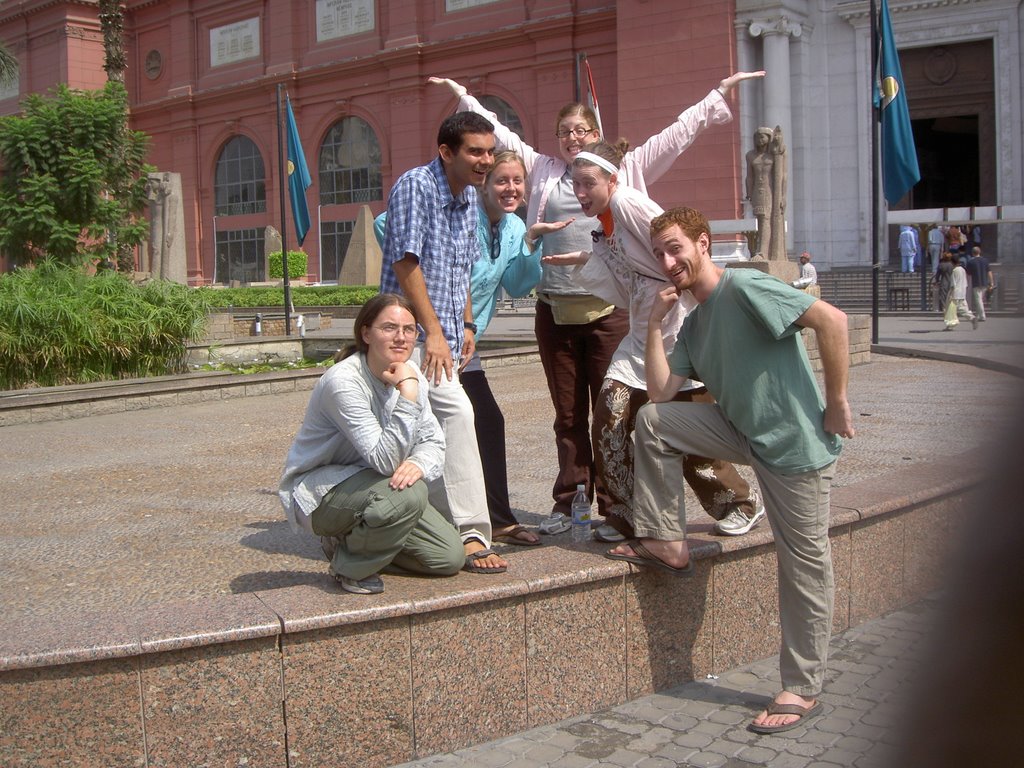
Here we are, dressed typically for us, outside of the Museum in Cairo. In this photo, we are making up for how we can't take the camera inside with us.


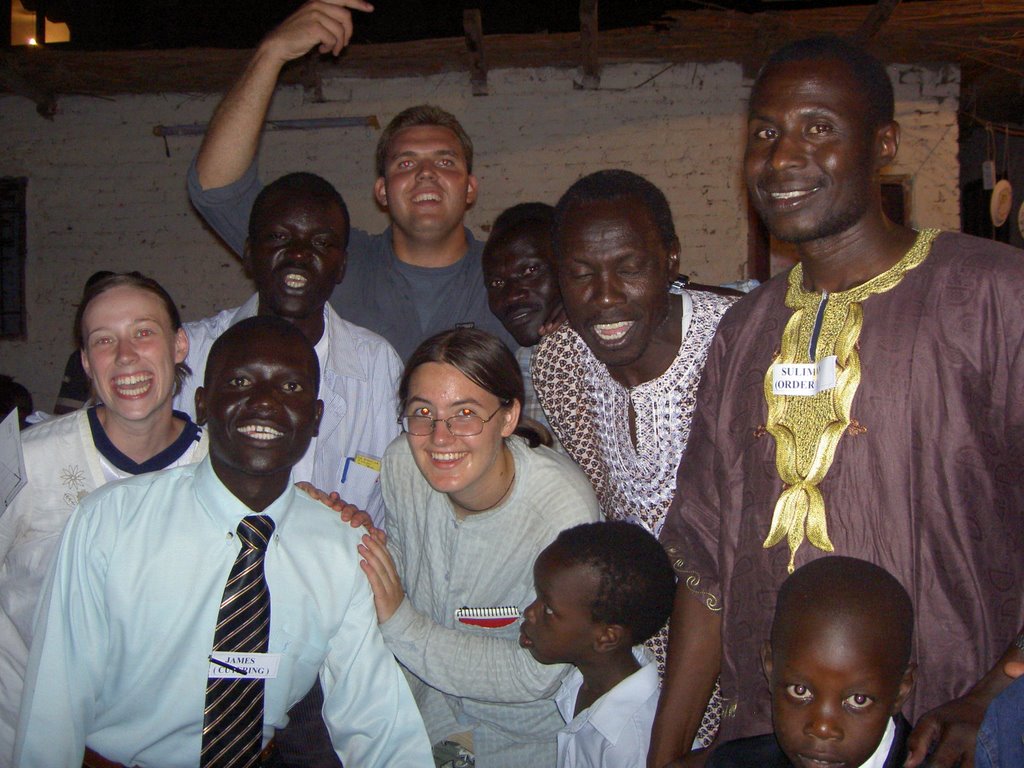
This is at the end-of-summer-school celebration at Central. Our teachers are dressed particularly neatly. It was a rather large, important, exciting event. Essentially, it was also our goodbye.


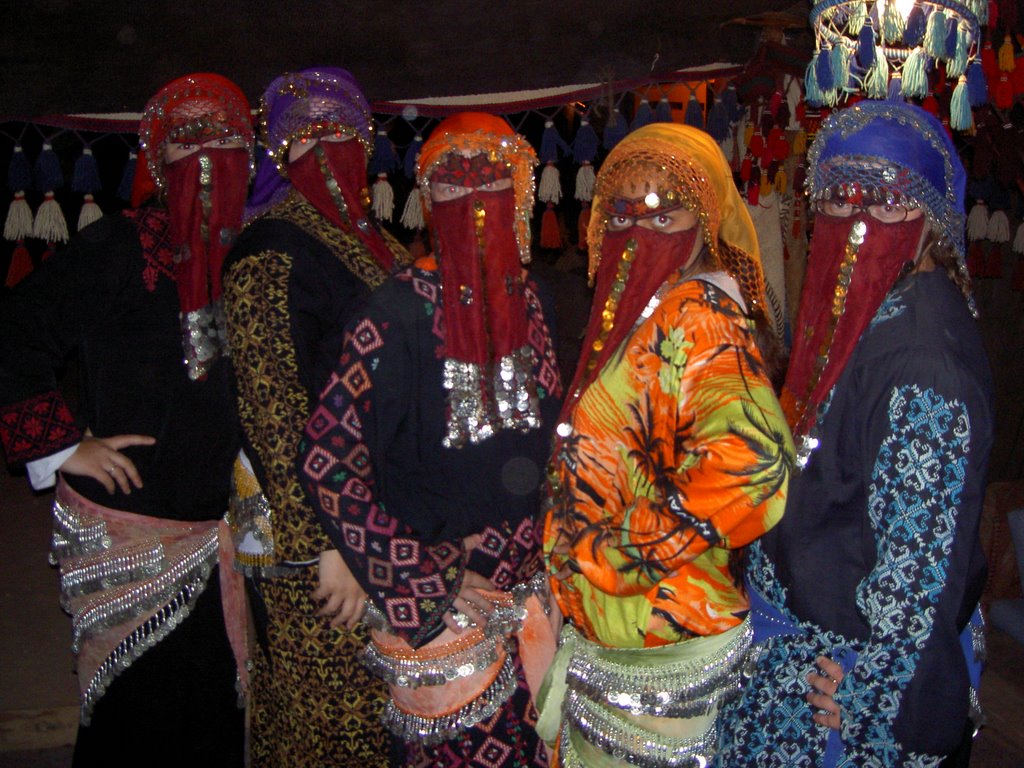
And this is the traditional garb of Americans in tourist traps.


The world might not be ready for The Beduoin Boy Band

11.08.2006

More Stories about Cairo

I wrote an article to the Quest about my summer in Cairo, the full text of which can be found HERE. But for further information and some context, I'd like to offer the following links.

  • The Art of Flight, a video made in Cairo about the refugee situation several years ago. There is a direct reference to ArbaA Wa-Noos which is the slum that I worked in. Based on what I saw, it seems like good reporting, and offers a lot of good information on what is practically happening.


  • My Journal updates from this summer (main links are to the Global Urban Trek: Cairo blog)

  • June 25 We are Refugees - (or here at the InterVarsity site)

  • God has Delivered us into Egypt - (or here at the InterVarsity site)

  • July 3 Walk Like an Egyptian - (or here at the InterVarsity site)

  • July 12 City of the Sun (or here at the InterVarsity site)

  • July 18 News! From the Outside! (or here at the InterVarsity site)

  • July 31 Leaving on a Jet Plane - (or here at the InterVarsity site)


  • The following are updates which did not make it onto the InterVarsity site. I am a little upset about this, since I think they contain some information that really needs to get out there. I term them 'Retro Updates' since I finished them once I got back to the States

  • begun July 21 Religion and Some Politics

  • continued Political Floccinaucinihilipilification or a ground-level view of the UNHCR in Cairo

  • started July 10 O-h-n Spells 'Cat' or ... Figuring out What we Actually DID.

    Relevant Links from the bottom of my Article

  • Tukul Crafts, self-reliance for refugees in Cairo (I want the bookstore to carry some of these items).

  • A Long Walk Home – short documentary done by last year's trek, hopefully coming soon to an MRC near you.

  • The Lost Boys
    and the film

  • Article about Mokattam, the Garbage Village


  • Thankyou for listening to a story that I'm carrying for others
    since they are not here to tell you themselves.

    10.13.2006

    Delayed Response

    Update: 11.08.06
    12:40

    For those of you finding your way here from the Quest article link, my original article is below.
    If you want more information, I just posted a good collection of links in More Stories about Cairo.

    But, here are the relevant links:

  • My online journal posts to the InterVarsity site

  • Global Urban Trek: Cairo, a new blog to hopefully collect the thoughts of everyone who went to volunteer in Cairo with InterVarsity this summer, displaying some of my updates which never made it to InterVarsity.

  • Derivations, my current blog
  • .

    Thanks.


    *****


    An article I just wrote for the school paper

    *****

    Greetings, fellow students.

    I realize it is somewhat late in the year, but I thought I’d share with you a sort of “What I did this Summer” article. It’s writing has been delayed by a combination of the inevitable schoolwork and a blatant not-knowing-what-to-say. The subject feels rather removed from our present situation, which is largely my own fault. For, it seems that if I really allowed my summer to influence me as much as I think it should, this would hardly be a ‘What I did this Summer’ article, and more of a ‘What I am Still Doing’ article. Unfortunately, I have allowed myself to slip through nearly 10 weeks without writing this article. So in a spirit of ashamedly delayed loyalty to my friends and teachers in Cairo, an obligation to share information with my fellow humans, and despite the communicative and length restrictions of a Quest article, I come bearing stories.

    Fifteen other college students and I went to Cairo this summer on a short-term missions trip with InterVarsity Christian Fellowship, an international Christian organization. Proselytizing is illegal in Cairo, and though we did meet some lawbreakers, our purpose in going was not to convert the Egyptian masses, but rather to serve in schools for Sudanese refugee children. We prepared for our trip in part by reading Quest for Hope in the Slum Community (articles compiled) by Scott Bessenecker, Slave: my true story by Mende Nazer, and Dispossessed: Life in our World's Urban Slums by Mark Kramer. Many Sudanese have fled to Cairo, hoping to gain passage to other countries. Many have been denied refugee status and are encountering discrimination in Cairo.

    There are no UN programs set up for the refugees to gain access to schooling or jobs. The UNHCR paperwork is nearly impossible to fill out and may never result in getting the refugees anywhere else. Many refugees are waiting for the promised phone call to inform them of their flight out. It was promised within weeks. It could come at any time. But, they have waited for years with no results. Many of the parents are not comfortable sending their children to Egyptian schools, for fear of either financial, religious, or racial problems. As a result, concerned refugee parents have gotten together in various locations and, often with help from churches or outside organizations, found the means to hire teachers and a classroom. I learned later that there are only 12 such refugee schools in Cairo. We served at 6 of them. There is no way that we met half of the refugee children in Cairo. I’m not sure exactly how I feel about paying college tuition for one of the best educations in the country when there are kids in the slum who can’t learn to read because their parents can’t afford the LE10 tuition (LE10 = 10 Egyptian pounds ~ $2 US).


    We lived for 5 weeks in a flat in Heliopolis – a relatively well-off section of Cairo. We split into groups to volunteer at 6 different schools. Every weekday morning (except for Fridays), two other volunteers and myself wedged our way onto bus for the 30-40 minute drive out to the slum community in ArbaA-wa-Noos (Literally, "4 1/2"). Walking through the dust between constant construction and half-finished buildings (completed buildings are subject to a city tax) past donkey-drawn carts every morning, we reached the square compound that was our school – Central (emphasis on the -ral). The compound formed a square with a gravelly-cement open space in between, spanned by a volleyball net. The rooms formed the perimeter of the square, with doors towards the volleyball ‘court’. The teachers we worked with were all Sudanese refugee men, and we quickly developed good friendships with them. The students ranged from ages of possibly 5 – I5, and they’re pretty awesome kids. I usually helped Leonardo teach either music or English. Marko, Emmanuel, Bouquet, and James were others of our good teacher friends at the school. Although the atmosphere at the school is mostly laid back, these men do not lead easy lives. They work multiple jobs to support themselves or their families while attending school and completing with UNHCR paperwork.

    We often wondered if we were actually helping in any way, since the teachers we worked with were more qualified to teach their students than we were. Emmanuel, one of the teachers from Central came to visit us early in the month at our flat to tell us how much he appreciated just the fact that we were there and cared about the Sudanese people. He told us that nobody had to care about the Sudanese people, yet we chose to come from America to try to help. He said it was things like this that gave him hope for his people and his country.


    And, they do have hope. Many of the children at our schools were planning their hopeful future education around developing skills to bring back to South Sudan. Sometimes, I felt like I was watching an entire people group in the early stages of resurrecting their homeland and their way of life. I thought they would just want to get out and start their lives over, but most of the refugees we talked to sincerely hope to return to South Sudan and rebuild. Their conflict is the one between North and South Sudan.

    The oversimplified problem is basically that the Arab government in the North wants all of Sudan to be Arab. However, something like 70% of Sudan’s people are black-skinned and not Arab. Thus, their villages are burned, their women are raped, their children are sold into slavery, and those that remain are taught to speak only Arabic. We actually met a man from Darfur who was pursued and tortured by the government for his crime of working to develop a curriculum to teach the children of the Fur tribe their native language.

    Everyone’s been tortured. It gets a little unreal sometimes. Of everyone that told us the story of how they escaped to Cairo from Sudan, they’d all been tortured - their wives, too. Some of them still have family left, but it’s very hard to keep in touch. Near the end of our trip, Emmanuel was telling us about his family, his life in Cairo, and his desire to return to Sudan. He asked us, "When you return to America, what will you do for us?"

    As Emmanuel told us earlier, ‘we must all lift each other up by sharing the things we know.’

    That is what I’m trying to do, and admittedly it feels somewhat futile. Before we left, Emmanuel asked us not to forget him. I hope I don’t, but the world I live in here is so different, it’s sometimes hard to remember exactly what was important during the summer. However, earlier this year, I attended a Darfur awareness/fundraising event put on by the Save Darfur Coalition. Ethan Rafel was there. He’d gone back to Africa and was in Darfur at the same time as I was in Cairo. He brought back stories about the kinds of threats that my friends in Cairo were fleeing from. I still don’t know what to do, but the event becomes more encouraging to me with the passage of time.

    So what can be done? I don’t know exactly. But, there are many good charities already set up in Cairo (and, I’m sure, in other cities filling with refugees). There are also many refugees with their blue cards (refugee status, awaiting relocation to a different country) who don’t have anywhere to go or anyone to receive them once they get there. I hear that individuals and churches can sign up to receive refugees, but I have yet to find out how this happens or where one can sign up. I have included a link to Tukul Crafts in this article. Tukul (too cool!) is run by and employs refugees, so anything you buy there will directly help refugees and refugee business. I might even know the guy who screens your shirt. There are many refugees relocated to America who are unfamiliar with the language and the customs. If you meet one, please be kind and helpful.

    And, take Emmanuel’s advice – ‘we must all lift each other up by sharing the things we know.’ Spread the word.

    Thanks for helping me pass along this information on behalf of others who are not here to tell you themselves. I hope that this article is a reminder to me as much as to you about the world outside the bubble, and even outside of America.
    If you have questions or comments, I would be happy to hear them.
    mehoket@reed.edu
    And, if there’s something I don’t know about, I still can talk with my friends and teachers on Gmail chat from time to time.

    I hope you’ll investigate the following links:

    Global Urban Trek: Cairo, a recently-started blog-in-progress for the combined experiences and thoughts of the other student volunteers as well as the friends we made in Cairo.

    Tukul Crafts, self-reliance for refugees in Cairo (I want the bookstore to carry some of these items).

    A Long Walk Home – short documentary done by last years’ trek

    The Lost Boys
    and the film

    an Article about Mokattam, the Garbage Village

    I did not talk about Mokattam in this article at all, but it is one of the most efficient garbage recycling systems in the world, returning about 80% of trash into some use. This is great, except that the method is for entire impoverished villages (mostly Coptic, and the most obviously Christian section of Cairo) to sort through the garbage produced by all of Cairo. One city’s trash is another city’s unfortunate livelihood.

    10.12.2006

    while awaiting the Apocalypse

    Transcribed from my notebook:
    ******

    10/12/06

    Tonight

    ~8:30

    We spoke of the apocalyptic genre in Religion today.

    I’m ready for the world to end tonight.
    I’m rolling to a stop, fortunately, Fall Break is the day after tomorrow.
    I feel weary, but rested.
    I am the right temperature
    I have been conscious all day, waking before my alarm
    I have done what I wanted, when I wanted to do it
    and I haven’t wanted much
    Fortunately, the things I want are good,
    Thus I found Real Analysis Homework in Foster I to be incredibly peaceful.
    Everything is peaceful.
    I do not want things that I don’t have.
    My memories are on the fonder side.
    DD’s dream sequence has been playing through my head
    And is a wholly appropriate soundtrack.
    I’ve been with friends, but not for too long
    I’ve been alone and calm
    I came home to delicious vegetable rice soup
    With ‘cornbread’ and German Chocolate cake
    Which I ate (not too much) by myself in a kitchen not too light, not too dark, empty, but comfortable while beautiful folk-sounding music played. I can only remember a chorus with the word ‘Dover.’ I wish I could tell someone how beautiful. Quietly, calmly beautiful.
    Beautiful like the Shiva candle which I am babysitting on my desk. The wax is folding into a pillow on top with age and warmth.

    If the world ended right now,
    I would stay right here.
    I feel comfortable like worn cloth

    The candle has surpassed its 24 hours
    And is ready for the breath that lets it rest.
    It is waiting contentedly and patiently,
    Perhaps not knowing when its time will come,
    But ready to fold itself in its own warm wax pillow.
    It awaits rest calmly and peacefully.
    Its end shall come tonight
    But mine continues.
    While I write, a speaker in the Chapel, whose lecture I wished to attend, is speaking on humanitarian concerns, including Darfur.

    Elsewhere, there is darkness in desperate need of candles even if for a little light to huddle near fearfully. Elsewhere, there are those with no friends and a loneliness that gnaws us to despair. Elsewhere, children wish to go to school, wish to play music, wish to eat even a handful of cold rice.

    And so my evening, for which I am grateful,
    My evening of everything detailed perfectly like a painting, my beautiful evening for which I wish, I wish there was someone nearby who is not busy, who is not sad, who is not exhausted or alone, who would understand how beautifully still, still like the hum of stars in a deep blue winter sky,
    How deeply still this evening has made me feel.
    Thankyou, God.
    Tonight is a thick oil painting of blues and purples, reds, yellows, orange
    Daubed heavily
    With weight
    But this is not everyone’s painting.

    Where will I go to find someone not exhausted? Not lonely, not despairing, not hungry who will sink with me tonight into the black velvet of a winter sky?

    My evening is not over.
    The world cannot end tonight
    Because if I will for one moment look beyond this frame,
    I see fear, I see despair, hatred, destitution,
    My own brothers and sisters,
    My own flesh & blood going without
    Without friends, without family, without food or hope or health or love

    And my world cannot end.
    I am grateful for this painting, but I cannot stay here until it can be for everyone.
    I will leave this frame and return to them, and together, we will work for a new world. This is not easy work. It will consume us.

    The Shiva candle is lit for Yom Kippur in memorial of the dead. I shall extinguish it now, may this evening go with it.

    Tonight’s the night the world begins again.